
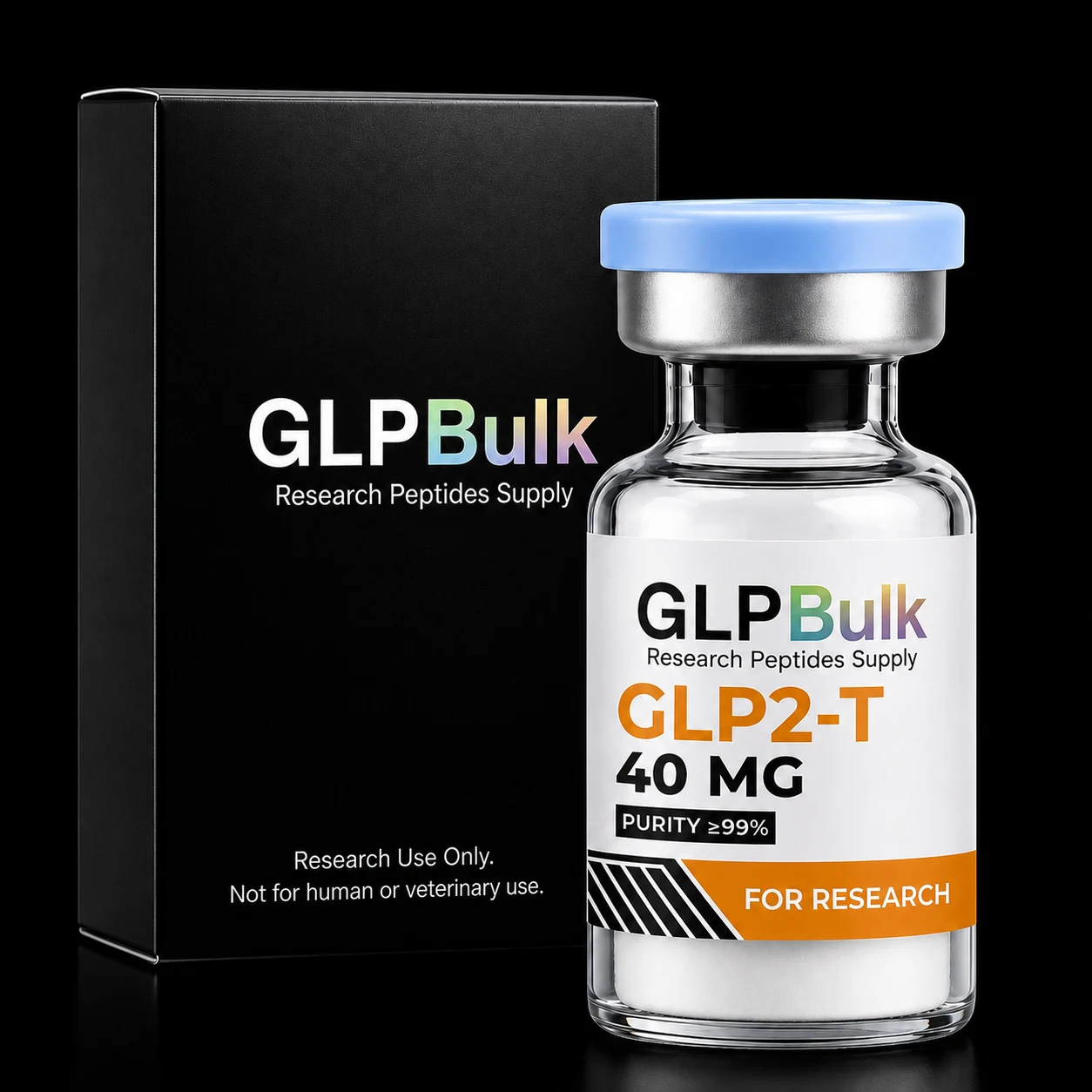
Lyophilized reference compound supplied at a baseline analytical purity threshold of ≥99%. Verified via independent third-party high-performance liquid chromatography (HPLC) and mass spectrometry (MS) profiling.
$129.99
| Quantity | 40 MG |
|---|
Independent Laboratory Verification
ANALYTICAL SPECIFICATION: Lyophilized reference compound supplied at a baseline analytical purity threshold of ≥99%. Verified via independent third-party high-performance liquid chromatography (HPLC) and mass spectrometry (MS) profiling. Strictly for laboratory research use only.
GLP2-T 40mg is a highly purified synthetic peptide variant engineered to function as a dual glucose-dependent insulinotropic polypeptide (GIP) and glucagon-like peptide-1 (GLP-1) receptor agonist. Structurally, the compound is an acylated peptide consisting of a 39-amino acid sequence. Its primary structure is genetically modified from the native GIP sequence, incorporating a C18 fatty diacid moiety attached via a linker at the lysine residue at position 20. This precise biochemical modification permits heightened stability against proteolytic degradation by dipeptidyl peptidase-4 (DPP-4) in controlled experimental settings.
In vitro assay designs evaluate GLP2-T for its dual binding affinities across human GIP and GLP-1 receptors. As a “twincretin” mimetic pathway, the peptide engages the GIPR and GLP-1R signaling networks, activating intracellular adenylate cyclase. This interaction prompts a downstream cascade resulting in increased cyclic adenosine monophosphate (cAMP) accumulation. In cellular and physiological laboratory models, researchers monitor this dual-agonist activity to study glucose-dependent metabolic responses, intracellular trafficking behaviors, and biased agonism profiles comparing native incretin behaviors to synthetic acylated analogs.
Within established animal models evaluating metabolic regulatory systems, GLP2-T is routinely utilized to map signaling pathways associated with energy homeostasis, nutrient processing, and pancreatic islet cell preservation. Researchers deploy this reference standard to investigate the synergistic effects of simultaneous GIP and GLP-1 receptor activation on central satiety pathways and peripheral gastric motility. The 40mg institutional presentation is specifically optimized for high-throughput automated laboratory screening, lot-to-lot baseline comparisons, and concentration-specific formulation assays.
LABORATORY COMPLIANCE DIRECTIVE: This material is supplied solely as a synthesized reference standard for laboratory evaluation, analytical benchmarking, and in vitro investigation. This product is not a drug, biological material, or therapeutic agent. It is strictly not intended for human consumption, veterinary application, or diagnostic implementation.
This tirzepatide research peptide is supplied at 40mg per vial in lyophilized form, verified through independent HPLC and mass spectrometry testing to confirm purity ahead of shipping. It’s intended strictly for laboratory and in-vitro research, not for human or animal use.
What sets tirzepatide apart from single-pathway peptides is its design as a dual agonist research peptide, engaging both GIP and GLP-1 receptors within the same molecule. Labs studying incretin signaling often use compounds like this to compare combined receptor activation against single-target peptides, particularly when looking at downstream cAMP response or receptor binding kinetics.
The 40mg format suits labs running concentration series or batch comparisons where consistent starting material matters across multiple assay runs. As with other listings on GLP Bulk, documentation from third-party testing is available to review before ordering, and the product ships from within the US.
Orders over $99 include free priority shipping, and most orders go out the same business day. A reconstitution solution is sold separately for labs preparing working dilutions once the compound arrives.
Researchers who’ve worked with single-agonist GLP-1 compounds sometimes reorder this one specifically to run side-by-side comparisons, since dual-receptor behavior doesn’t always scale predictably from single-pathway data. Account holders can review past orders directly, which helps when tracking batch numbers across a longer study.
By accessing this website, you confirm that you are at least 21 years of age and acknowledge terms of service.